

Key takeaways
- AI recommendations are not a fixed ranking. Give your business a better chance of being considered by making it easy to find, understand and verify.
- Start with seven WordPress fundamentals: crawler access, indexing, clear business descriptions, useful answers, consistent details, independent mentions and visible proof.
- A Google ranking, a verified business profile or schema markup does not guarantee a recommendation in ChatGPT, Gemini or Google’s AI features.
- Check real customer questions in English and Arabic, repeat the tests, and compare the brands mentioned over time rather than trusting one AI answer.
When customers ask AI for a recommendation, does your business appear?
Imagine a customer asking, “Which dental clinic in Dubai offers evening appointments?” Or a business owner typing, “Who can help us with cybersecurity compliance in the UAE?” An AI assistant may respond with a short list of businesses before that customer ever visits a website. If your company is absent, you may never enter their consideration set.
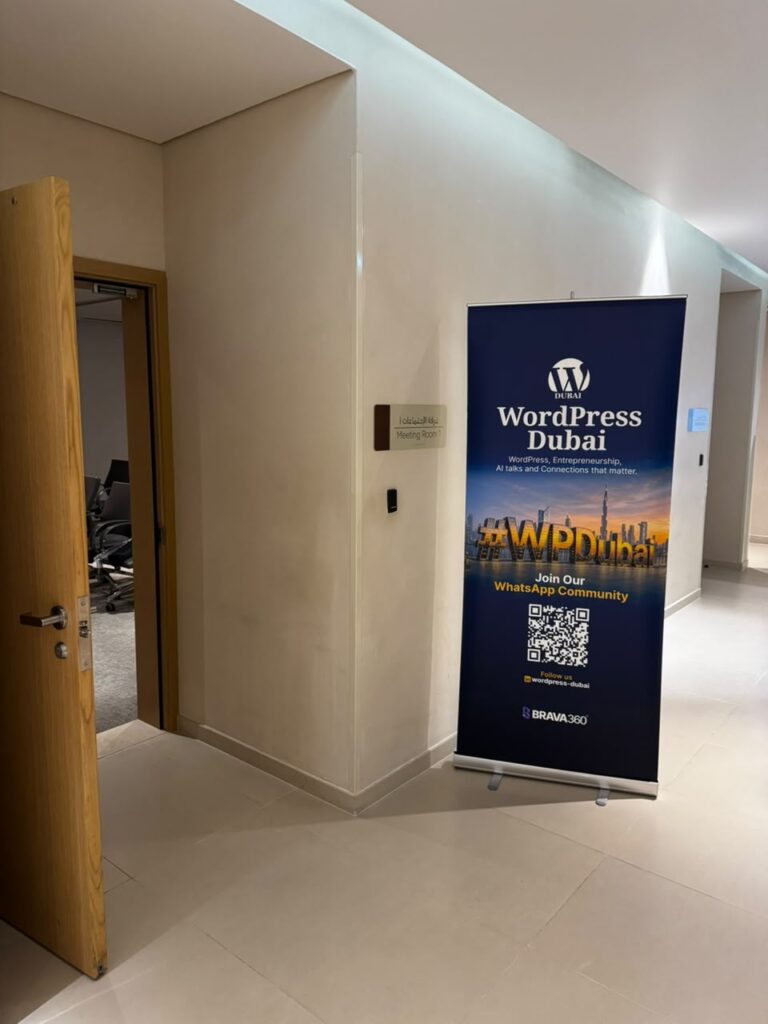
At the November 2026 Dubai WordPress community meetup, Ali Hassan, General Manager at BRAVA 360 DIGITAL, presented “How to Get Your Business Recommended by AI.” The talk translated a complex topic into seven changes WordPress website owners can make without chasing shortcuts or promising a place in AI-generated answers.
The central framework was simple: an AI system needs to be able to find your business information, understand what you offer and encounter credible evidence that supports it. These are useful priorities, not a published formula for how every AI model selects businesses. You can also view Ali’s original Dubai Meetup presentation.
Why AI visibility starts with familiar search fundamentals
Search engine optimization (SEO) helps search systems discover and evaluate useful pages. Answer engine optimization (AEO) focuses on clear answers to relevant questions. Generative engine optimization (GEO) considers how people and brands are represented in AI-generated responses. In practice, these activities overlap. Google explicitly advises website owners to keep doing fundamental SEO work for its AI features, rather than adding a special “AI optimization” tag.
Some assistants retrieve current web pages, while other answers may also reflect model knowledge and product-specific systems. That means no single WordPress setting can make all AI products recommend your business. Google also says that meeting its technical requirements does not guarantee indexing or inclusion in AI results. Read Google Search Central’s AI guidance.
Lesson 1: Make sure AI search crawlers can reach your website
A well-written service page cannot help an assistant that cannot access it. WordPress sites sometimes block bots through robots.txt, a firewall, a security plugin or a content delivery network. In WordPress, check Settings → Reading and make sure “Discourage search engines from indexing this site” is not selected for a public business website.
Then ask your hosting or security team whether relevant search crawlers are allowed. OpenAI identifies OAI-SearchBot as the crawler used for ChatGPT search discovery; GPTBot is a separate training crawler and a separate policy decision. Do not assume that permitting one means permitting the other. The lesson is to check accessibility deliberately, not to disable necessary security.
Lesson 2: Help search engines find your important pages
Your homepage might be indexed while a valuable service page is not. Check your top service, location, pricing and contact pages in Google Search Console and Bing Webmaster Tools. Submit a reliable XML sitemap from your WordPress SEO plugin and investigate accidental noindex settings, broken links or conflicting canonical tags.
Being indexed is not proof of being selected by an AI system. For Google’s AI Overviews and AI Mode, however, Google says a supporting link must be indexed and eligible to appear in Search with a snippet. This is why basic indexability checks belong near the top of the worklist.
Lesson 3: Say what you do, where you work and who you help
“Innovative solutions for every need” tells a potential customer almost nothing. A clearer description would be: “Family dental clinic in Al Barsha, Dubai, offering appointments in Arabic and English, including evenings.” The details are illustrative, but the principle is real: explain your actual service, location, audience and relevant constraints in plain language.
Put that information in visible text on the homepage and relevant service pages. Align the page title and meta description, and do not bury essential details in graphics. For UAE and GCC businesses, give Arabic-language visitors an equally useful description when the language is part of your service experience. A clear website also helps people decide whether to call, book or request a quote.
This is the thinking behind Websites Built to Be Found: a site should make your offer understandable to both people and the systems they use to discover businesses.
Lesson 4: Answer the questions customers actually ask
Your buyers may ask “How much is a villa deep clean in Dubai?”, “Can I book a Friday appointment in JLT?” or “What is included in a website maintenance plan?” A generic paragraph packed with keywords is less useful than an accurate answer that names the service, price conditions, timing, eligibility and next step.
Use the real question as a heading when it reflects genuine customer demand. Answer it directly, then explain the details. Add examples, service areas, qualifications or a clearly defined process where they are relevant. Google recommends original, non-commodity content rooted in real experience, not dozens of nearly identical pages manufactured for different prompt variations.
Emotional intelligence matters here. People asking “Is this clinic reliable?” or “Who will answer if something goes wrong?” are expressing uncertainty, not merely using keywords. Helpful content responds with verifiable facts, honest boundaries and practical reassurance instead of exaggerated promises.
Lesson 5: Keep your business facts consistent
If your website, Google Business Profile and directory listings show different business names, phone numbers or service areas, a customer has reason to doubt which details are right. Choose the correct, current version and make it consistent. Use your SEO plugin to describe your organization accurately through supported structured data, but make sure any schema matches what visitors can see.
For local businesses, Google says local results consider relevance, distance and prominence. Accurate profiles, relevant services and legitimate reviews can support local discoverability, but they do not constitute a fixed AI recommendation score. Neither schema nor a verified badge guarantees selection by an assistant.
Lesson 6: Earn credible mentions beyond your own website
A company’s website explains its own offer. Independent sources help a buyer check it. Depending on your sector, useful evidence may include genuine Google reviews, relevant professional directories, association memberships, local media coverage, expert interviews and contributions to communities.
Not every mention is equally useful, and paid or manufactured endorsements should not be presented as independent proof. The goal is not to produce as many brand mentions as possible. It is to make accurate, useful information about your business available in places your customers can reasonably trust.
For a closer look at which competing companies already appear in AI responses, see the previously published article Which Competitors Do AI Assistants Recommend Instead of Your Company?.
Lesson 7: Show real people, proof and up-to-date information
Anonymous service pages, unsupported “number one” claims and outdated prices make buying decisions harder. Add meaningful author or team biographies where relevant. Show credible qualifications, dated projects, case studies with approved results, and clear contact information. Update important pages when the facts change, and use genuine update dates rather than changing them just to look fresh.
This also helps the people arriving from AI answers. Even if an assistant recommends you, the visitor still needs enough evidence to choose your company over alternatives. Credibility works best when the website experience, public information and independent sources tell a consistent story.
What should you avoid spending money on?
The Dubai Meetup presentation warned against three shortcuts: assuming an llms.txt file is the missing solution, looking for a secret AI markup tag, and publishing large quantities of generic AI-written posts. Google states that its generative search features do not require new AI text files or special structured data, and advises against content produced primarily to manipulate visibility.
Use AI tools to assist with genuine work such as organizing customer questions, preparing outlines or reviewing repetitive reporting. Human review is still needed to validate claims, keep customer information private and decide whether the output actually helps someone. The best generative AI tool is the one that fits the task, integrates with your workflow and lets your team verify its results. ChatGPT or Gemini may help draft and analyze material; they do not automatically validate it or make a website recommended.
How do you know whether the seven lessons are helping?
Start with a repeatable set of real buyer questions, not an occasional screenshot. Ali’s presentation proposed testing ten questions each month across relevant AI experiences, including English and Arabic versions where appropriate. Record the exact question, platform, date, your business’s presence, competitor names and cited sources when available.
Repeat the same method across sessions and over time. Separate a brand mention from an explicit recommendation and a clickable citation. Supplement your tests with Search Console, Bing Webmaster Tools and business enquiries. AI answers vary, so one test is not a permanent ranking or proof that a specific website edit caused a change.
Which marketing insights and tools are worth connecting to this work?
A business owner looking for an AI-driven marketing solution with detailed insights should ask a precise question: does the tool show where we appear, what competitors are mentioned, which public sources support the result and what action we should take? An attractive dashboard without a documented method is not enough.
For competitor benchmarking, combine repeat AI prompt tests with search visibility, service-page coverage, local listing accuracy, independently supported claims and conversion experience. For automation, start with repetitive tasks such as collecting results, flagging changed business details, consolidating notes or preparing review drafts. Choose automation based on data protection, transparency, integration needs and the ability to inspect the raw evidence.
An agency offering AI-personalized marketing is not necessarily an agency that measures AI search recommendations. If you are choosing a provider, ask for a sample methodology, evidence of quality control, relevant market and language coverage, and clear reporting definitions. Avoid “best agency” lists that cannot disclose their criteria or independently substantiate their comparisons.
BRAVA 360 DIGITAL provides AI Visibility Audits and Competitor Analysis & Market Intelligence to help businesses examine discoverability and competitor evidence. These tools provide a starting point for investigation, not a guarantee of placement in AI recommendations.
Your next step: make your WordPress site easier to find, understand and trust
You do not need to rebuild every page or adopt a new plugin to begin. Start with the pages customers use to decide whether your business is right for them. Check access, verify indexing, sharpen the explanation of your services, answer real questions, align business details and strengthen credible proof.
For the original examples and the presentation framework, view Ali Hassan’s Dubai WordPress Meetup slides.
If you want a clearer picture of where your company currently stands, explore AI Visibility & Search Optimization at BRAVA 360 DIGITAL and start with a visibility review grounded in real questions and evidence. Better discoverability is a process to measure and improve, never a guaranteed AI recommendation.
Sources and references
- Ali Hassan, “How to Get Your Business Recommended by AI,” Dubai WordPress Meetup presentation, November 2026
- Google Search Central, “Optimizing your website for generative AI features on Google Search”
- Google Search Central, “AI features and your website”
- OpenAI, crawler information (OAI-SearchBot and GPTBot)
- BRAVA 360 DIGITAL, “Which Competitors Do AI Assistants Recommend Instead of Your Company?”, November 9, 2026